Wednesday, April 27, 2011

April 27, 2011 Is a garden a natural area?

No, but more and more gardens feature native plants.  DeFries Gardens, River Preserve County Park at 17477 County Road 46, New Paris, IN 46553 has an intriguing display of both  domestic cultivars and native plants.  The Calendar Garden displays plants by months of the year, with native plants on the outside of the circular brick path and domesticated plants on the inside.  When we were there today, April 27, we were fortunate to find designer and gardener Jon Cutrell pulling invasive plants from the native section of "April".  Beth DeFries, the visionary benefactor of the gardens, provided many of the unusual native plants.  For years she collected native plants and established them on the property where she and her husband lived for years.  Many of those plants are now in the formal calendar garden and many remain throughout the surrounding woods and informal gardens.  We were fortunate to have Beth D. as our neighbor in Goshen for several years.  We witnessed first-hand her passion for planting native plants; some of them persist in our neighbor's garden years after Beth moved away.

Cutrell has also collected and transplanted native plants from Indiana, his native Pennsylvania, and other eastern states.  He agreed to comment in this blog if information in this entry is wrong or incomplete.

Below are labeled photos of some of the native plants from the "April" section of the garden:
Virginia Bluebells, Martensia virginica - So far we have seen these grow naturally only in woods south of US 6


A multiple-petaled Bloodroot, Sanguinaria canadensis; these occur rarely in nature; we have only seen these in the DeFries Gardens


A multiple-petaled Rue Anemone, Thalictrum thalictroides - another rare occurrence  


Barren Strawberry, Waldensia fragaroides  They grow natively in Indiana south of Indianapolis.

In the woodland gardens we found many native species in bloom today:
Prairie Trillium  Trillium recurvatum
Toad Trillium  Trillium sessile
Large-flowered Trillium   Trillium grandiflorum
False Rue Anemone  Enemion biternatum
Spring Beauty  Claytonia virginica
Marsh Marigold  Caltha palustris
Dutchman's Breeches  Dicentra cucullaria
Squirrel Corn  Dicentra canadensis
Jack-in-the-Pulpit  Arisaema triphyllum
Yellow Trout Lily  Erythronium americanum
Common Blue Violet  Viola sororia
Long-spurred Violet  Viola rostrata
Yellow Violet  Viola pubescens
Cream Violet  Viola striata
Purple Springcress  Cardamine douglassi
Wild Ginger Asarum canadense


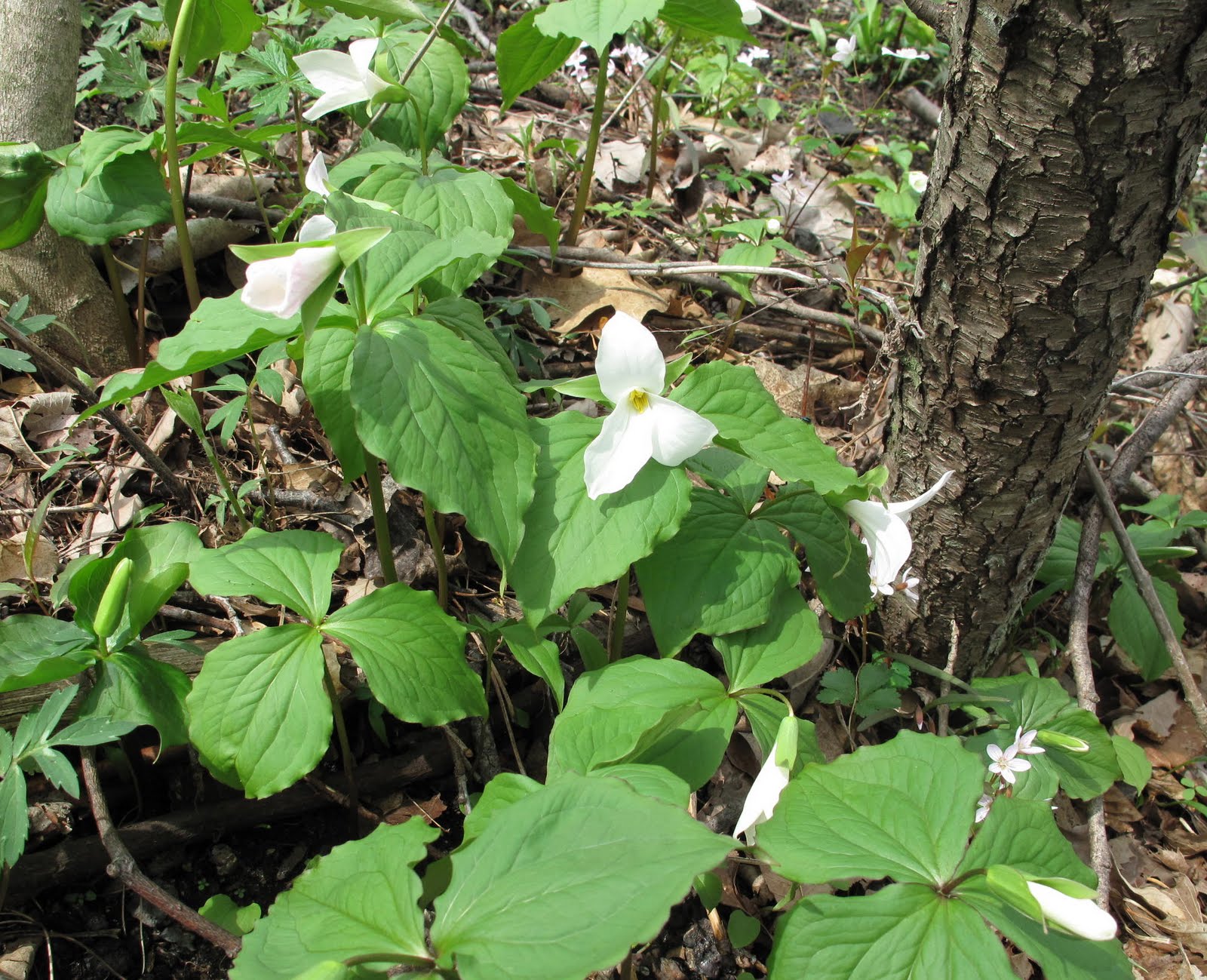
Foreground: Toad Trillium; background: Prairie Trillium


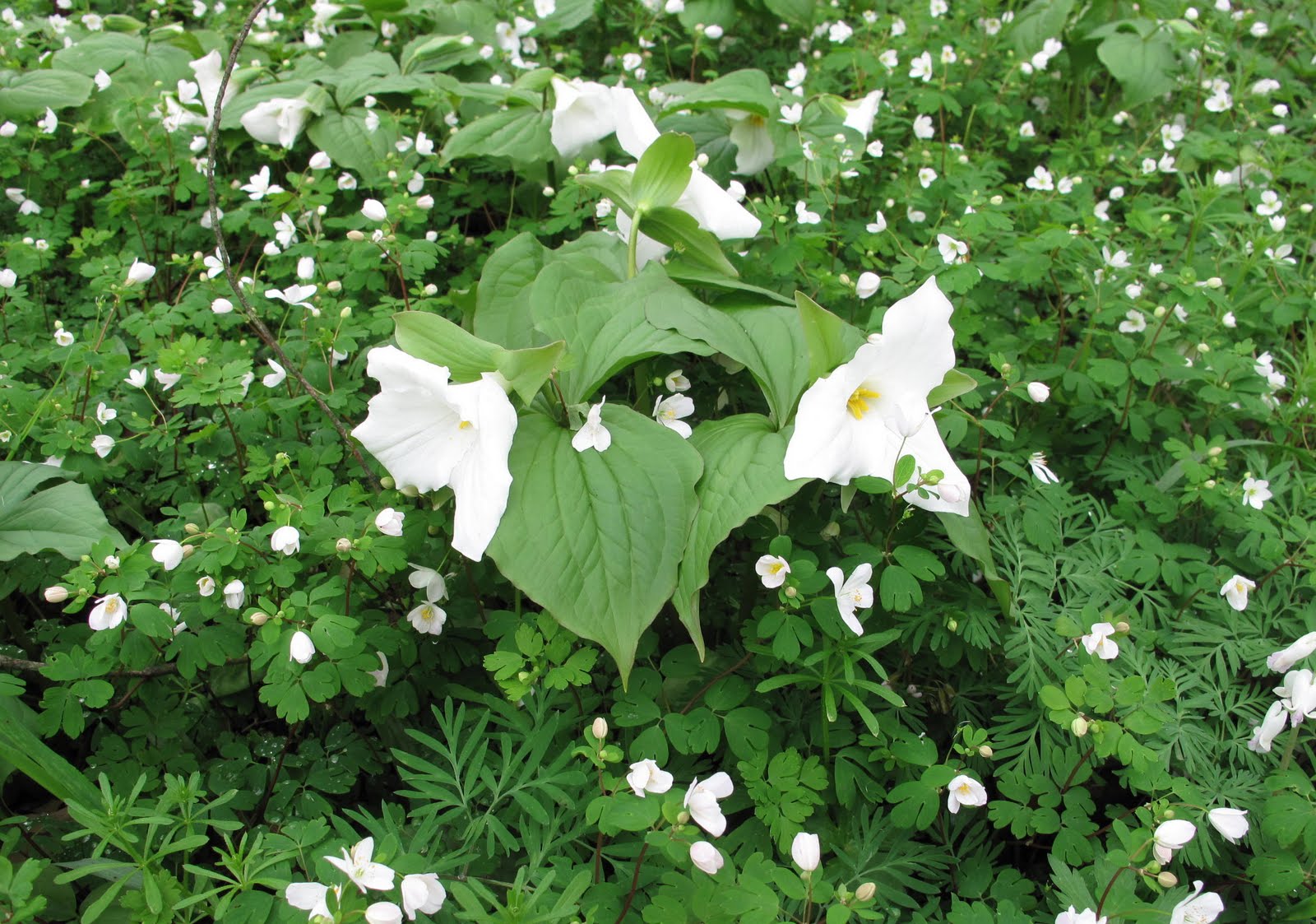
Large-flowered Trillium surrounded by False Rue Anemone


Cream Violet, Viola striata - note the stripes on the lower petal

April 26, 2011 Two Wooded Sections of the Pumpkinvine

Yesterday I looked for what was blooming along two wooded sections of the The Pumpkinvine Nature Trail  - 1.) the section under construction from Elkhart CR 43 east, half-way to LaGrange CR 1150, and 2.) the completed trail near Elkhart CR 33.  The woods near CR 33 are more mature and appear to have been less heavily logged and grazed than the woods near CR 43.  There are some beech in the CR 33 section, but not at CR 43.
Beech tree on west side of the trail just south of CR 33


Looking west down the Pumpkinvine from the bridge under construction in section of trail west of CR 43

This is the first time I've been to the CR 43 section in the spring.  Her is what was blooming 4/26/11:
Spring Beauty - Claytonia virginica
Round-lobed Hepatica  - Hepatica nobilis  var. obtusa
Bloodroot - Sanguinaria canadensis  It is surprising how many Bloodroot are blooming in late April.
Purple Springcress - Cardamine douglassi
Spicebush - Lindera benzoin
Common Blue Violet - Viola sororia
Yellow Violet - Viola pubescens
Blue Phlox - Phlox divaricata
Larged-flowered Trillium - Trillium grandiflorum  Not fully open; many in bud.
Large-flowered Bellwort - Uvularia grandiflora  Many of these relatively uncommon flowers.
Large-flowered Bellwort Lily Family
This is the fourth time I've walked the CR 33 section this spring.  All of the flowers listed in our April 21 & 17 entries are still blooming. Yellow Trout Lily, Spring Beauty and Common Blue Violet are at their peak.
Yellow Trout Lily  Lily Family

Spring Beauty  Purslane Family
Common Blue Violet  Violet Family


New bloomers as of 4/26/11 are -

Large-flowered Trillium  - Trillium grandiflorum
Blue Phlox - Phlox divaricata
Buttercup - Ranunculus species ??
Large-flowered Trillium  Lily Family

Blue Phlox  Phlox Family
 Below is a most unusual "bloomer" that decorated the trail on 4/26/11!

Sign propped up on a tree on trail just south of CR 33

April 26, 2011 Shoup-Parsons Woods

Flooded section of Shoup - Parsons Woods
Shoup - Parsons Woods is a Goshen Parks property just below the Goshen Dam.  Currently a small section of the trail is flooded by the Elkhart River, but most of the trail is passable.  There is a surprising diversity of plants in this small, heavily used woods.  Yesterday the following were in bloom:


Common Blue Violet - Viola sororia
Yellow Violet - Viola pubescens
Cut-leaved Toothwort - Cardamine concatenata
Purple Springcress - Cardamine douglassi
Toad Trillium - Trillium sessile
Prairie Trillium - Trillium recurvatum  (Flowers just beginning to open.)
Spring Beauty - Claytonia virginica
False Rue Anemone - Enemion biternatum
Buttercup - Ranunculus  species  (Uncertain which species of Buttercup this is.)
Jack-in-the Pulpit - Arisaema triphyllum  (Just coming up)
Dutchman's Breeches - Dicentra cucullaria
Spicebush - Lindera benzoin  (A shrub; the pistil will develop into an aromatic red berry)

Buttercup
False Rue Anemone
Jack-in-the-Pulpit, just coming up

Tuesday, April 26, 2011

April 26, 2011 A Church with a Nature Preserve?

Yes, Waterford Mennonite Church, south of Goshen on IN SR 15, has a nature preserve.  We go there from April through September to see what's blooming.  The church web site explains:

"The church building is located on a 61 acre tract. Fifty-five acres is a forested floodplain wetland located along the Elkhart River, 2 miles upstream from the city of Goshen.  Besides is obvious value to wildlife, this wetland also benefits Goshen and surrounding communities by serving as a storage area for floodwaters-- thus reducing flood damage to downstream properties. When inundated, this area slows the flood water and allows it to soak into the groundwater, thus improving water quality by removing sediment and other contaminants.  A maintained system of elevated loop trails is used by the local community for walking and bird watching.  ... By protecting and managing this unique asset for the benefit of the congregation, community and God's creation, Waterford Mennonite Church exhibits another way it lives out it's core value of Stewardship."

Right now there is fine show of Marsh Marigold (Caltha palustris , Buttercup Family) in the wetlands, the best we have seen anywhere so far.  From the southwest corner of the parking lot, walk down to the pond and follow the elevated loop trail counter-clockwise.  Within 50 yards you will begin seeing in the low swamp to the west with huge areas of Marsh Marigold flowers and Skunk Cabbage plants.
Marsh Marigolds
As you continue around the pond you will see the work of beavers.  Wood Anemone (Anemone quinquefolia, Buttercup Family) and Dog Violet (Viola conspera, Violet Family) grow here and there along the trail.
Wood Anemone or Windflower

Dog Violet
 Why is it called "Dog Violet"?  I have no idea.  It's lighter blue than the "Common Blue Violet" and has a 1/4 in. rounded spur at the back of the flower.  We haven't seen Dog Violet many places.

Monday, April 25, 2011

April 25, 2011 In search of a White Trout Lily

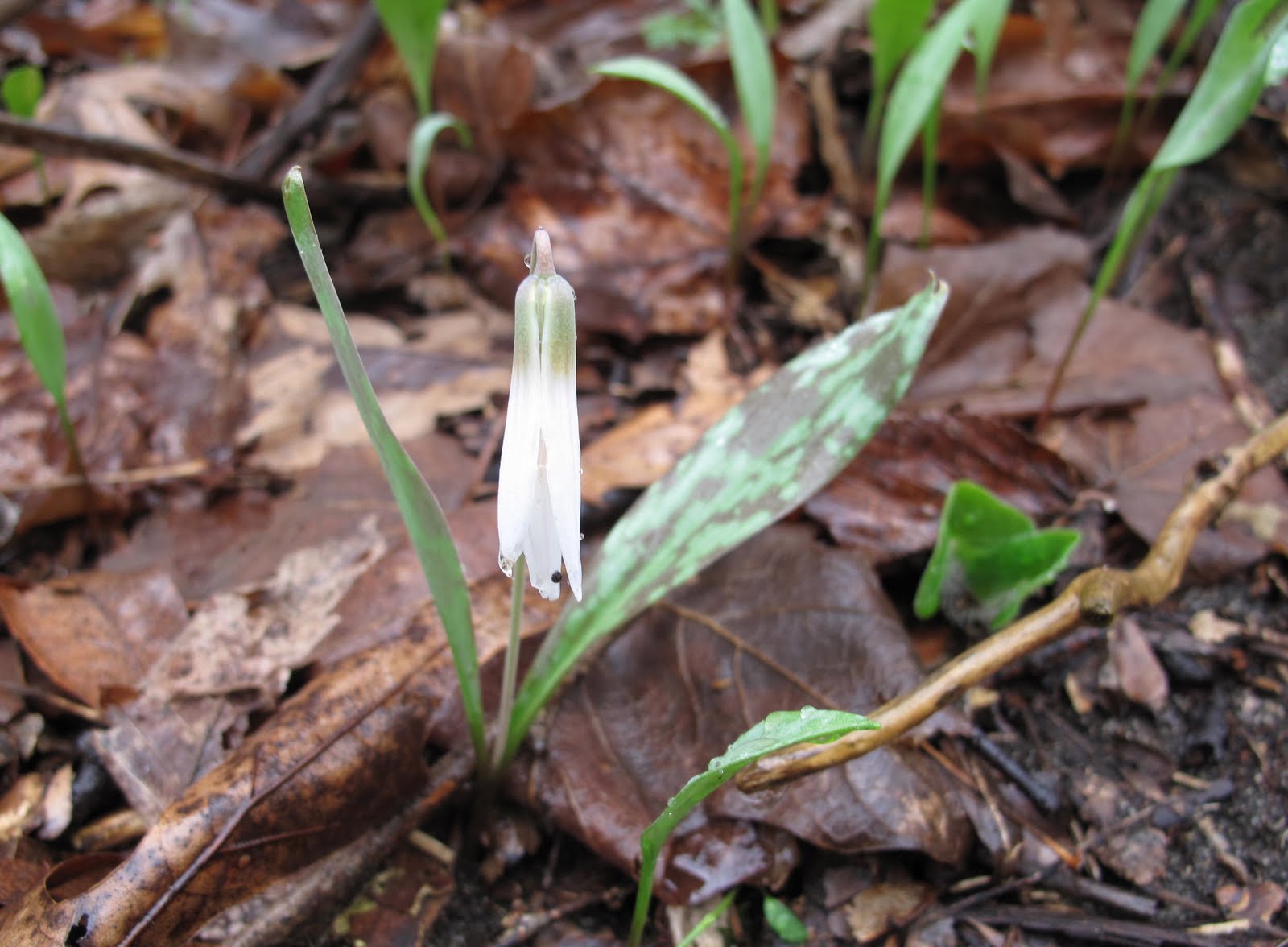
We've seen Yellow Trout Lily (Erythroium americanum) in several woods this year, but not the White Trout Lily (Erythronium albidum), which is much less common.  We've seen it at Oxbow County Park other years, so when I came past the park today, on the way home from Elkhart, I couldn't resist, in spite of the light rain, stopping to see if it is in bloom.  I wasn't disappointed.
White Trout Lily drooping in the rain, near Coffee Tree Shelter #2
Also blooming in the park were -

Spring Beauty - Claytonia virginica
Dutchman's Breeches - Dicentra cucullaria
Common Blue Violet -  Viola sororia
Purple Springcress - Cardamine douglassi
Cut-leaved Toothwort - Cardamine concatenata
False Rue Anemone - Enemion biternatum
Spicebush - Lindera benzoin
Buttercup - Ranunculus species (Perhaps R. hispidus, Swamp Buttercup)
Toad Trillium - Trillium sessile

Another Trillium, Prairie Trillium (T. recurvatum) is in bud stage - it will bloom soon.

While walking on the central trail through the woods I saw a group of 5 deer; 2 ran away and 3 just stood there and looked at me.  A Sandhill Crane flew overhead.

April 24, 2011 - An Easter Walk in the Woods


Toad Trillium, photo by Tiya Sumihe
After Easter dinner, twelve family and friends (including 5 kids, ages 9-14) enjoyed the Elkhart River, canal and woods at the Benton Dam at River Preserve County Park.  What fun to watch kids climb up and walk on every fallen log.  And from time to time they took a break to see what was blooming. We searched in vain for Jack-in-the-Pulpits, which are late this year.  In addition to the flowers listed on our April 21 hike at Benton Dam, we saw our first Cream Violet (Viola striata) of the year. Numerous Toad Trillium (Trillium sessile) were in full bloom (photo above).  More Large-Flowered Trillium (Trillium grandiflorum) were in flower than 3 days earlier, but their best show is yet to come.
Large Flowered Trillium, photo by Tiya Sumihe


April 23, 2011 - Wildflower Hike at Bender Memorial Forest - ACRES

Sixteen hikers gathered Saturday afternoon, April 23 at Bender Memorial Forest - ACRES Land Trust on River Road, west of Albion, IN to enjoy the early wildflowers.  Joann and John helped identify the flowers as needed and pointed out plants that will flower later in the season.  The following species were in bloom:
Spring Beauty - Claytonia virginica
Rue Anemone - Thalictrum thalictroides
Marsh Marigold - Caltha palustris
Skunk Cabbage - Symplocarpus foetidus
Dutchman's Breeches - Dicentra cucullaria
Toad Trillium - Trillium sessile
Common Blue Violet - Viola sororia
Cut-leaved Toothwort - Cardamine concatenata
Purple Springcress -  Cardamine douglassi
Sharp-lobed Hepatica - Hepatica nobilis  var. acuta
Round-lobed Hepatica - Hepatica nobilis var.  obtusa
Harbinger of Spring  - Erigenia bulbosa
Yellow Trout Lily - Erythronium americanum
Bloodroot - Sanguinaria canadensis
Spicebush - Lindera benzoin
Spring Beauty - photo by Nadine Kline, hike participant.
Note the characteristic pink veins in the petals.
Bloodroot - photo by Nadine Kline


Yellow Trout Lily - photo by Nadine Kline


Hikers saw Eastern Box Turtles at two different places in the forest.
Eastern Box Turtle
Black cup fungus fruiting bodies
Black cup fungus fruiting bodies were growing on this fallen branch; the mycelia of the fungus are likely growing throughout the branch.  We saw these fruiting bodies at several places in the forest.

Another ACRES-sponsored wildflower hike is scheduled at Bender Forest for 10 a.m. Saturday, May 28.  We will  see quite a different set of flowers in bloom then.