Sunday, August 14, 2011

Orchids Near You

In my August 11 post, Wildflowers Far Away in Newfoundland, I included pictures of three orchids and noted there are orchids in Indiana too. Michael Homoya describes over 40 species in his book Orchids of Indiana.  But they are hard to find -- most are not showy and some are rare. Often they grow in remote or wet areas that are difficult to access.  In ten years of looking for orchids within  reasonable drive distance, I have only found eight species; I have taken photos of six species.   Below are my photos of Indiana Orchids, in the sequence they bloom.  (Please double click on the photos to enlarge them.)
Showy Orchis, Galearis spectabilis, Orchid Family, early May
Twayblade, Liparis lillifolia, Orchid Family - late May
Puttyroot flowers, Aplectrum hyemale, Orchid Family, late May
Puttyroot leaves, September to May
Puttyroot leaves begin emerging in September and stay green until May, when they die back.  In late May the leafless flower stalk emerges.  I have found Puttyroot in three woods in Elkhart and LaGrange Counties.
Shining Ladies' Tresses, Spiranthes lucida, early June
A botanist first told me of a fen in Whitley County where this orchid grew.  I went immediately and found it.  A week later I was walking in a wetland in Elkhart County and happened upon it.  Neither Homoya's Orchids of Indiana, nor the USDA Plants Data Base report Shining Ladies' Tresses in Elkhart County.
Rattlesnake Orchid, Goodyear pubescens, July & August
 Rattlesnake orchid gets its common name from the prominent white leaf veins that make the leaves look a bit like rattlesnake skin.  The attractive leaves last through the winter.
Nodding Ladies' Tresses, Spiranthes cernua, Sept.
Nodding Ladies Tresses tend to grow in bogs and other wetlands.  I have seen them in a flotting sphagnum bog in Elkhart, County and in a wet prairie in Noble County.

I have seen both Pink Lady's Slipper, Cypripedium acaule and yellow Lady's Slippers, Cypripedium calceolus in Michiana, but I haven't found them scince I started photographing wildflowers.  I will keep on the lookout for them. 


Saturday, August 13, 2011

August 13, 2011 Wildflowers Around Baintertown Pond

Baintertown Pond is in the Baintertwon Park section of River Preserve County Park.  Many native wildflowers thrive between the edge of the pond and the grassy path.  The flowers pictured below are in the order we saw them as we walked around the east pond.
Partridge Pea, Chamaecrista fasciulata - Pea Family
Field Thistle, Cirsium discolor - Sunflower or Aster Family


Field Thistle is one of several native thistles that grow around Goshen.  There are also introduced thistles, such as Canada Thistle and Bull Thistle, that invade native plant communities.

Tall Ironweed, Veronia gigantea - Sunflower or Aster Family
Swamp Milkweed, Asclepias incarnata - Milkweed Family
Swamp Loosestrife,  Decodon verticillatus - Loosesrtife Family
Rose-Mallow, Hibiscus moscheutos - Hibiscus Family
Halberd-Leaved Rose-Mallow, Hibiscus laevis -Hibiscus Family
The flowers of both species of Rose-Mallow may be pink or white.  The easiest way to distinguish them is leaf shape.  The Halberd-Leaved Rose-Mallow has leaves that are shaped like an ancient European weapon, the Halberd.

Winged Monkeyflower, Mimulus alatus - Figwort Family
The Figwort Family includes Snapdragons and many local, native plants with irregular flowers.
Blue Vervain, Verbena hastata - Vervain family
Obedient Plant, Physostega virginiana -  Mint Family
Below is a list of other native plants in bloom near the pond:

Prairie Rosinweed,  Silphium integrifolia, Sunflower Family
Gray-Headed Coneflower, Ratibida pinnata, Sunflower Family
Common Fleabane, Erigeon philadelphicus, Sunflower Family
American Indian Hemp,  Apocynum cannibinum - Dogbane Family
Common Evening Primrose, Oneotera biennis, Evening Primrose Family
Horsemint, Monarda punctata, Mint Family
Horse Nettle, Solanum carolinense - Nightshade Family
Pale Indian Plantain, Arnoglossum atriplicifolium - Sunflower Family
Pokeweed, Phytolacca americana - Pokeweed Family
Jerusalem Artichoke, Helianthus tuberosa -Sunflower Family

The following introduced (i.e., not native) plants are in flower near the pond:

Queen Anne's Lace, Daucus carota - Carrot Family
Bouncing Bet, Saponaria officinalis - Pink Family
Common Mullein, Verbascum thapsus - Figwort Family

Friday, August 12, 2011

August 11, 2011 - Prairie Wildflowers at Boot Lake


Boot Lake Nature Preserve, northwest of Elkhart, IN includes a reconstructed prairie. The web site documents this valuable reconstruction from a former sewage slag dump. Many native prairie plants are now in bloom.

From the parking lot I took the lane past the tree nursery to the prairie, continued on that wide mowed path through the prairie and looped right on "Prairie Pike", right again on "Purple Coneflower Pass"  and right a third time to return again to the nursery lane, where I turned left to return to the parking lot.

In late summer there are so many species of wildflowers in the "Sunflower" or "Aster" Family.  Even after studying Newcomb's Wildflower Guide (see book review), frequently I am uncertain of the species.  Please feel free to enter comments and questions regarding my identification.
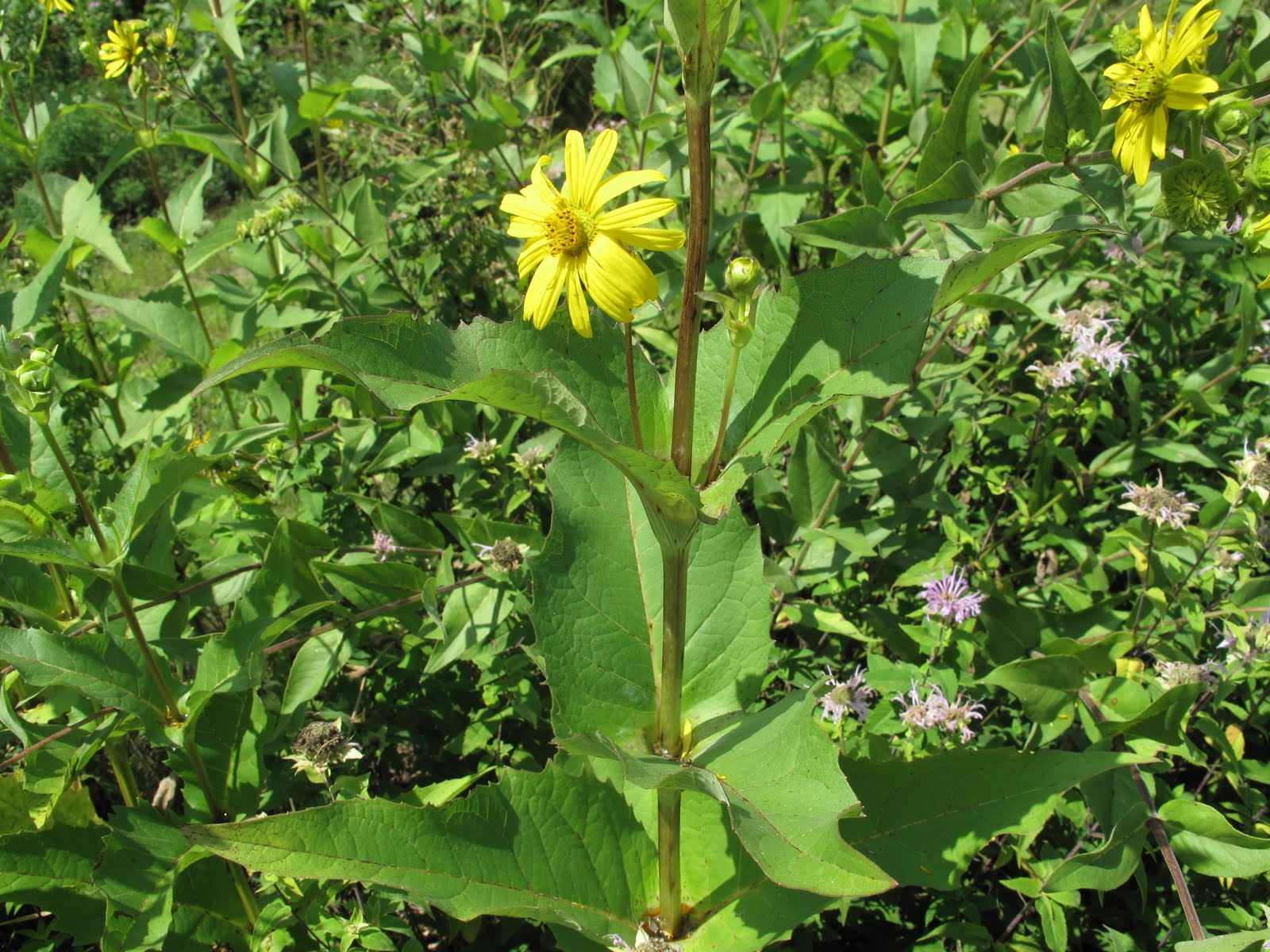
Flowers of Cup-Plant, Silphium perfoliatum

Joined opposite leaves of Cup-Plant
Four species of the genus Silphium are blooming.  Species of this genus have similar flowers, but because each Silphium species has unique leaves, identification is easier than for many other plants in the Sunflower or Aster Family.  Note how the opposite Cup-Plant, Silphium perfoliatum, leaves join together to form a cup; during rains, water collects in the "cups".  Cup-Plants grow as high as 8-9 feet.

Prairie Rosinweed, Silphium integrifolium
Prairie Rosinweed leaves are opposite like Cup-Plant, but they are smaller and do not join to form a cup.  Rosinweeds are shorter than Cup-Plants.

Prairie Dock, Silphium terebinthinaceum
Prairie Dock's huge leaves form a whorl at the base of the plant.  A thin flower stalk bolts up to 10 feet.
Compass-Plant, Silphium laciniatum
Compass-Plant also has huge basal leaves, but  each leaf is deeply cut.  It too bolts a 10 foot flower stalk.
Purple Coneflower, Echinacea purpurea
Purple Coneflower is also a member of the Sunflower Family.  Extracts of Echinacea roots are used in herbal medicine.
Wild Quinine, Parthenium integrifolium
Wild Quinine is another member of the Sunflower Family that is used in herbal medicine.   You will have to walk off the path to find this plant at Boot Lake; there aren't many plants.
Flowering Spurge, Euphorbia corollata
Flowering Spurge is part of the Spurge Family, as is Poinsetta.  A milky sap exudes when a leaf breaks off the stem.
Whorled Milkweed, Asclepias verticillata
"Milk" also flows from broken milkweed parts, but Milkweeds are a separate family from Spurges.  Whorled Milkweed flowers, leaves and stems are all much smaller than the Common Milkweed, but the flower structures are the same, i.e., the five petals curled up and the five sepals curl down.  Double click on the photo to see the flowers more closely.
Wild Bergamot, Monarda fistulosa
Wild Bergamot has a square stem, in cross section - an indicator that it belongs in the Mint Family.  It is a very common field and roadside plant.  Bee-Balm is also in the Monarda  genus.
Canada Tick-Trefoil, Desmodium canadense, Pea Family
Blue Vervain, Verbena hastata, Verbena Family
Other native plants now in flower at Boot Lake Prairie are -

Common Fleabane                     Erigeron philadelphicus                     
Gray-Headed Coneflower          Ratibida pinnata                                 
Jerusalem Artichoke                  Helianthus tuberosa                            
Field Thistle                               Cirsium discolor                                  
Lance-Leaved Goldenrod          Solidago graminifolia                         
Common Evening Primrose       Oenothera biennis                              
Narrow-Leaved Mountain Mint Pycnanthemum tenuifolium                

Introduced, i.e., not native, plants in flower are -

Spotted Knapweed                     Centaurea maculosa                           
Bouncing Bet                             Saponaria officinalis                           
Deptford Pink                            Dianthus armeria                                
Common Mullein                      Verbascum thapsus                               
Queen Anne's Lace                   Daucus carota                                      
Yellow Sweet Clover                Melilotus officinalis                              
White Sweet Clover                  Meliotus alba                                       
Red Clover                                Trifolium pratense                                
White Clover                             Trifolium repens                                   

Wildflowers Far Away in Newfoundland

Ten weeks have passed since our last post.  During that time we drove 7,250 miles in our Prius to and from Newfoundland and Labrador, Canada. (You may want to check the  Newfoundland and Labrador Tourism web site.)  Although our blog focuses primarily on wildflowers within 50 miles of Goshen, Indiana, we will share some of the flowers we found in Newfoundland and Labrador.  Early July is a prime flowering time there.   

(Please note: You may enlarge photos by double clicking on them.)
Pitcherplant
The Northern Pitcherplant, Sarracenia purpurea, is the provincial flower of Newfoundland and Labrador.  We saw it in many bogs and fens across the province.  There are a few sphagnum bogs in Indiana where we have found it too, including Lieber Nature Preserve near Bristol, IN.
Labrador Tea
Labrador Tea, Ledum groenlandicum, is also very common in Newfoundland, but does not occur in Michiana.  It is a member of the Heath family, which includes blueberries, laurels, rhododendrons and azaleas.
Sheep Laurel
Sheep Laurel, Kalmia angustifolia, often grows in bogs with Labrador Tea and Pitcherplants.

Blue Flag Iris at Gros Morne National Park

Blue Flag, Iris versicolor, grows in wet areas throughout Newfoundland.  We have another Blue Flag species, I. virginica, in Indiana. Gros Morne National Park is a wonderful place of landlocked fjords, ancient mountains, and picturesque harbor villages.
Twinflower
Twinflower, Linnea borealis, is a boreal [i.e., arctic]  plant, as the name indicates.  It is common in Newfoundland, but does not grow in Indiana.
Cloudberry or "Bake-apple"

Plumboy
Cloudberry or "Bake-apple", Rubus chamaemorus, and Plumboy, Rubus articus, are two close relatives of raspberries and blackberries that grow in northern climes.  At several of our "bed and breakfasts" and restaurants we enjoyed yellow bakeapple jam and pie.  The red Plumboy berries are not plentiful enough to make jam.  Neither grow in Indiana.

Two tiny species of Dogwood
 Bunchberry, Cornus canadensis, on the right, and Sweedish Bunchberry, C. suecica, on the left, are dogwoods that grow only a few inches high.  C. canadensis grows throughout northeastern U. S. and Canada [including Steuben, Lake & Porter Counties in Indiana].  C. suecica, the smaller of the two, is primarily an arctic plant.

Roseroot Stonecrop along the Gulf of Saint Lawrence
Roseroot Stonecrop, Sedum rosea, grows in dry rocky shores and cliffs.  We saw it on the rocky cliffs of an island near Bonavista, Nfld  where puffins were nesting.  It does not grow in Indiana.
Dragon's Mouth

Pink Lady's Slipper

Flat-petaled Yellow Lady's Slipper
Orchids don't grow only in Hawaii and greenhouses.  There are many native orchid species in Newfoundland and Indiana.  Dragon's Mouth, Arethusa bulbosa, grows in wetlands in Newfoundland; there have been a few reports of Dragon's Mouth in Indiana, but there are no pictures to document them.

We saw Pink Lady Slippers at several places in Newfoundland.  The only places we have seen it in Michiana are Pinhook Bog, Indiana Dunes National Lakeshore and Fernwood Botanical Garden and Nature Preserve.

We were pleased to find the rare "Flat-petaled Yellow Lady's Slipper", Cypripedium parviflorum var. pubescens, in bloom at Burnt Cape Ecological Preserve at the northern tip of Newfoundland.  Burnt Cape is an appropriate name - the terrain is rocky, dry and windswept.  Nonetheless, many rare plant species grow there.


Wednesday, June 1, 2011

Taking a Break

Now that the woodland flowers have nearly finished their show for the season, we are taking a break from posting on our wildflower blog.  We plan to resume posting in late July, 2011.  Our focus then will be wildflowers in wetlands, prairies, old fields and roadsides. 

Below are parting shots of uncommon wildflowers we found in the past week within 50 miles of Goshen.

Hoary Puccoon, Lithospermum canescens
Puttyroot, Aplectrum hyemale

Late May Woodland Flowers: Spurgeon

As the tree canopy has become more dense, the number of wildflower species in bloom at ACRES Spurgeon Woodland Preserve has declined.  Nonetheless, I enjoyed my quick walk there Saturday afternoon, May 28, in spite of the drizzle; unfortunately, the darkness triggered the flash mode. (You may click on the photos to enlarge them.)

False Solomon's Seal and Broad-Leaved Waterleaf were the dominant flowers in bloom.
False Solomon's Seal, Maianthemum racemosum
False Solomon's Seal, closer up
Broad-Leaved Waterleaf, Hydrophyllum canadense
For the first time this year, I found Wild Sarsaparilla blooming, near the vernal pond.  The USDA Plant Database reports that it grows in most counties in the northern third of Indiana.  The leaves and flowers grow on separate stalks that emerge from the underground stem.

Wild Sarsamparilla, Aralia nudicaulis
Three Wild Sarsaparilla inflorescences
Wild Sarsaparilla leaves
 In the 30 minute hike I saw the following native flowers, in addition to those pictured above:

Canada Violet, Viola canadensis
Cream Violet, Viola striata
Wild Geranium, Geranium maculatum
Blue Phlox, Phlox maculatum
Aniseroot, Osmorhiza longistylis

I couldn't resist photographing the interesting mushrooms that have appeared with all the rain of the past weeks.